%201.svg)


Salesloft alternatives that cost less and go live faster
Summary
Salesloft is a strong sales engagement platform. It is also quote-only, annual-contract-only, and takes roughly a month to implement, which rules it out for most companies under 50 people regardless of how good the product is.
- Salesloft publishes no pricing. Third-party contract data puts it at roughly $125 to $165 per user per month at list price.
- The dialer is an add-on on every tier, reported at around $300 to $400 per user per year.
- G2 reviewers report about 1 month to implement. Onboarding packages are sold separately.
- Cheapest real alternative: Instantly at $37.60/month on annual billing, if all you need is cold email.
- Fastest to activate: Thriwin (disclosure: that is us) - free to start, then $100/month flat, and most customers are live in days.
- Closest like-for-like swap: Apollo at $49/user/month on annual billing, with a contact database built in.
Most people searching for Salesloft alternatives have already asked what Salesloft costs and been told to book a call. That is the standard process, and for a lot of small companies it is where the evaluation quietly ends.
Salesloft earns its reputation. It has been in sales engagement since 2011, its cadence builder handles branching logic across email, call and social steps, and it holds a 4.5 rating from more than 4,200 G2 reviews. Reviewers name the Salesforce sync and the cadence workflow more often than anything else. For a 40-rep revenue org with a sales ops person, it is a defensible choice.
It was built for that org, though, and the assumptions show. The pricing model assumes an annual budget cycle. The implementation assumes someone whose job description includes owning the tool. Neither assumption holds at 12 employees.
This article covers six alternatives, with pricing verified against each product's live pricing page in September 2026. Every product gets its real limitations listed, including ours.
How we researched this article
Every product's pricing was verified directly against its live pricing page in September 2026. User reviews were sourced from G2, Trustpilot, and Reddit. Feature claims were checked against each product's current feature pages. Salesloft does not publish pricing, so the figures below come from third-party contract and procurement data and are labelled as estimates throughout.
Thriwin is the publisher of this article and is included in the comparison. We've been as honest about our limitations as everyone else's. If you spot an error, contact us and we'll correct it within 48 hours.
4 reasons Salesloft doesn't fit small businesses
1. You cannot find out what it costs without a sales call
Salesloft's pricing page has a "Contact Us" button where the numbers should be. Its G2 listing shows the same thing: both the Advanced and Premier plans are listed as "Contact Us" with a demo request. There is no published rate card and no free tier.
Third-party contract aggregators fill the gap. Multiple 2026 pricing trackers put list price at roughly $125 to $165 per user per month, dropping to about $100 to $130 per user per month after negotiation for mid-market deals. One analysis of Vendr negotiation data reports typical discounts of 35 to 45 percent off list, which tells you the first number you see is never the real number.
Quote-only pricing is workable for a buyer with a procurement process and a shortlist. For a company of 8 trying to choose between three tools this month, it mostly reads as an obstacle.
What a 5-person team actually pays
At the reported $125 to $165 per user per month list range, 5 seats runs $625 to $825 per month, or $7,500 to $9,900 per year before anything else.
Add the dialer at a reported $300 to $400 per user per year and you are at $9,000 to $11,900 per year. Salesloft does not include a contact database, so budget for Apollo or a similar data source on top. Reported implementation fees on larger deployments run $5,000 to $15,000, though small teams typically buy a lighter onboarding package.
2. The dialer is an add-on, on every plan
Calling is not included in either the Advanced or the Premier tier. The dialer is sold separately on both, at a reported $300 to $400 per user per year, with LocalDial numbers billed at about $1 per number per month.
Most small B2B teams run email and phone together, so the seat price covers about half the motion they came for. Worth asking for an itemized quote rather than a headline number.
3. Annual contracts, with no way to test first
Salesloft plans are quote-based and require annual contracts, with no monthly billing option. There is no free plan as of 2026, and the pricing page lists no free trial. Contracts commonly auto-renew, and many include automatic annual increases in the 5 to 8 percent range.
The practical effect is that you commit for a year before you know whether the tool suits your motion. Teams still testing their ICP are the ones this catches out.
4. It takes about a month to get running
G2's own "Time to Implement" figure for Salesloft, averaged across real user reviews, is 1 month. That matches what reviewers describe: onboarding takes weeks rather than days, admins need training, reps need training, and lean teams feel the friction.
Salesloft sells onboarding as a professional service, with packages running from basic to fully customizable. That is a reasonable thing to offer an enterprise rollout. It is also a cost and a calendar dependency a three-person team has to absorb before anything ships.
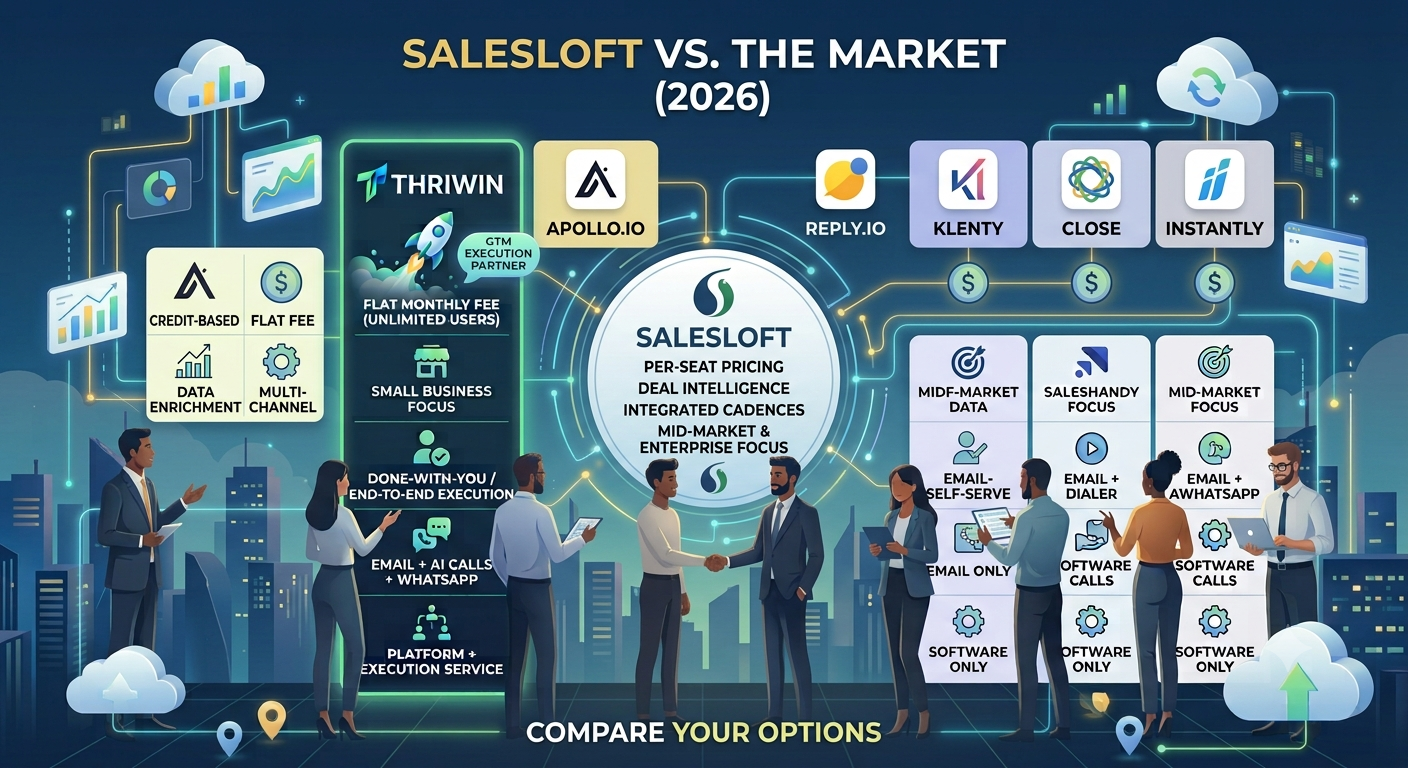
Quick comparison table
Six alternatives, each solving a different part of the problem. Salesloft is included for reference. Prices are entry-tier, annual billing where offered.
| Salesloft | Apollo | Thriwin | Reply.io | Klenty | Close | Instantly | |
|---|---|---|---|---|---|---|---|
| Entry price | Quote only | $49/user/mo | Free, then $100/mo | $49/user/mo | $50/user/mo | $9/user/mo | $37.60/mo |
| Pricing model | Per seat | Per seat | Flat, no seats | Per seat | Per seat | Per seat | Flat, no seats |
| Free tier | No | Yes | Yes, 200/day | Yes | 14-day trial | 14-day trial | 14-day trial |
| Monthly billing | No, annual only | Yes | Yes | Yes | Annual | Yes | Yes |
| Lead data included | None | 230M+ contacts | Yes - built in | Credits | 200 credits/mo | None | Paid module |
| Calling | Paid add-on | Professional+ | AI + manual dialer | Paid add-on | Growth+ | Growth+ | No |
| No | No | Yes | Yes | No | No | No | |
| Landing pages and ads | No | No | Yes | No | No | No | No |
| Someone helps run it | Paid onboarding | No - self-serve | Yes - done-with-you | AI SDR from $500/mo | No | No | No |
| Typical time to live | ~1 month | Days | Days | Days | Days | Days | Same day |
Per-seat prices multiply by headcount. Flat prices do not. Thriwin's $100 flat fee is not a subscription on top of usage - it is redeemable against the credits you spend on AI calls and AI tokens inside the platform.
1. Apollo
Apollo is where most teams leaving Salesloft end up. It covers the same job and adds a contact database, which Salesloft does not include at any tier, so prospecting, sequencing and dialing happen in one place.
The free plan is real but thin. It is enough to test the database, not enough to run outbound on.
Where Apollo beats Salesloft
- Published pricing, monthly billing, and a free tier you can test on today.
- A contact database of 230M+ verified contacts included, which Salesloft does not offer at any price.
- Dialer included from the Professional tier rather than sold as a separate add-on.
Where Apollo falls short
- The credit system is the real price. Credits are pooled across the team and expire at the end of the billing cycle. Reviewers consistently report effective costs running well above the sticker price once reveals and exports are counted.
- Mobile credits run out fast. A Basic seat gets 75 mobile credits a month, and phone reveals cost several credits each, enough for roughly 9 phone numbers before the allowance is gone.
- Calling is not its strength. Reviewers rate the dialer as adequate rather than good, and international dialing is gated behind the top tier.
Teams who want Salesloft's sequencing plus a lead database, and are willing to manage credit consumption to keep the bill predictable. More detail in our Apollo.io alternatives comparison.
2. Thriwin
Disclosure: this is us. We'll be clear about where Salesloft is the better choice, and there are several places where it genuinely is.
Thriwin is a lead generation platform rather than a sales engagement tool, and that distinction matters for this comparison. Salesloft expects you to arrive with a list, a message, and a rep to run the cadence. Most companies we work with do not have those yet, and building them is the actual job.
You start free. The paid plan is $100 a month flat, and that fee is redeemable against the credits you use for AI calls and AI tokens, so it is a floor on your spend rather than a subscription stacked on top of usage. No per-seat pricing, no contact limits, no workflow caps.
Calling covers both modes. AI calling runs the volume outreach, and there is a manual dialer for your team to work the list themselves, which is the thing Salesloft charges $300 to $400 per user per year for as an add-on. Email, calling, WhatsApp, landing pages and ads run as one system rather than five subscriptions.
Most customers are live in days. That comes from how the setup runs rather than the product being thinner. We build the campaigns, lists, messaging and sequences with your team instead of handing over a login and selling an onboarding package, so people learn the system by watching it get built. Results usually start before training would have finished.
Where Thriwin beats Salesloft
- Free to start, then $100/month flat with no seat multiplier, versus a per-user quote that scales with headcount.
- Live in days rather than the 1 month G2 reviewers report for Salesloft, because we build the system with your team instead of training them on an empty platform.
- AI calling and a manual dialer are both included, where Salesloft sells the dialer separately on every tier.
- Lead data and done-with-you execution included, so there is no separate data subscription and no "who is going to run this" problem.
Where Salesloft beats Thriwin
- Cadence depth. Salesloft's branching, multi-step cadence builder is more sophisticated than ours. If you run 12-step sequences with conditional logic across segments, you will feel the gap.
- Conversation intelligence and coaching. Salesloft records, transcribes and scores rep calls for coaching. We do not do rep coaching at all.
- Enterprise CRM and forecasting. Salesloft's Salesforce sync, deal management and forecasting modules are built for revenue orgs with real pipeline governance. Thriwin is not a CRM and does not try to be.
- Database size. Apollo's 230M+ contact database is larger than ours. If raw list volume is the constraint, Apollo wins.
- Email scale. For 100,000+ sends a month, Instantly and Smartlead are built for that volume and we are not.
"I tried Mailchimp, HubSpot, Apollo - none generated a single lead. They all needed someone to run them. Thriwin was different. I set it up, and it worked. 9 meetings in the first month."
- Tim Thomson, CyberTrends, MSP Business Consulting
Companies under 50 employees with no dedicated SDR, who need campaigns running this month and cannot spare anyone to administer a platform. Not for 20-rep orgs with a sales ops function, or teams whose main need is rep coaching.
3. Reply.io
Reply.io is the nearest thing to Salesloft's multichannel model at a published price. Sequences span email, LinkedIn, calls, SMS and WhatsApp, and it carries a 4.6 rating on G2 across more than 1,500 reviews.
Where Reply.io beats Salesloft
- Published pricing and a free tier, so you can evaluate before signing anything.
- Native LinkedIn and WhatsApp steps, which Salesloft does not offer.
- Entry price roughly a third of Salesloft's reported list rate.
Where Reply.io falls short
- The $49 plan is email-only. Multichannel is $89 per user, and LinkedIn and calling arrive as further per-account add-ons on top. The headline price is not the multichannel price.
- The AI agent is a separate subscription starting in the hundreds per month, not an included feature, so teams buying Reply for the AI-first promise pay the platform, the add-ons and the agent.
- LinkedIn automation carries account risk. LinkedIn actively detects and restricts automated activity, and a suspended rep account has real downstream cost.
Teams of 3 to 10 running genuine multichannel outbound who already have good contact data and want Salesloft's shape at a published price.
4. Klenty
Klenty comes closest to Salesloft's approach on this list. It is built around structured cadences and deep CRM sync, and priced deliberately below Outreach and Salesloft for SMB and mid-market buyers.
Where Klenty beats Salesloft
- Published pricing at roughly a third to half of Salesloft's reported rate.
- Multichannel and CRM sync unlock at $70 per user, with the dialer included rather than sold separately.
- Bidirectional CRM sync that reviewers rate as genuinely deep for the price.
Where Klenty falls short
- Startup is email-only. Phone, LinkedIn, SMS and CRM integrations all require Growth at $70, so the $50 entry price is misleading for most teams.
- No built-in email warmup. You will need a separate warmup tool for new sending domains, which is both an extra cost and an extra setup step.
- Prospecting credits are tight. The Pro tier includes 200 credits a month, and each email or phone lookup consumes one.
- Billing is annual. The listed per-seat prices assume an annual commitment.
Teams that want Salesloft's structured cadence discipline and CRM rigour, at a price a 6-person company can approve without a board meeting.
5. Close
Close is a CRM with calling in the core product rather than sold alongside it, which is the line item Salesloft charges extra for. It holds a 4.7 rating on G2 across more than 1,000 reviews, and reviewers cite the built-in dialer and ease of use most often.
Where Close beats Salesloft
- Calling, email and SMS included in the platform rather than sold as a dialer add-on.
- A genuine entry tier at $9 per user, and monthly billing at every level.
- It is a real CRM, so you are not paying for Salesloft plus a CRM underneath it.
Where Close falls short
- The dialer you want is gated. Power Dialer requires the $99 Growth tier and Predictive Dialer requires the $139 Scale tier, so the $9 headline is not the outbound price.
- Phone credits bill on top of every plan, and add-ons push effective per-seat cost 40 to 75 percent above the sticker. Calling-heavy teams typically land at $130 to $180 per seat all-in.
- No lead database. Close manages the relationship, it does not find the prospect. Budget separately for data.
Inside sales teams of 3 to 20 whose motion is primarily phone, who want the CRM and the dialer to be the same product.
6. Instantly
Instantly solves a narrower problem than Salesloft, and solves it cheaply. Outreach plans are flat-rate rather than per-seat, with annual billing roughly 20 percent below the monthly rate.
The flat-rate model is the main reason small teams pick it. Headcount does not change the bill.
Where Instantly beats Salesloft
- Flat pricing that does not multiply by headcount.
- Unlimited sending accounts and unlimited warmup included at every tier.
- Live the same day, with no onboarding package to buy.
Where Instantly falls short
- It is email only. No calling, and LinkedIn automation is not included at any tier. If your motion needs phone, this is not a Salesloft replacement.
- The lead database is a separate subscription. So is the CRM module. A working stack of sending plus leads plus CRM typically runs $124 to $180 a month rather than the headline $47.
- The Growth tier caps at 1,000 active contacts total, not per campaign, which most teams exhaust inside a month and then upgrade.
Founders and small teams running email-only outbound who already have their own lists and want the lowest possible sending cost.
When Salesloft is genuinely the right call
None of this makes Salesloft a bad product. It is aimed at a larger company than the one reading this. Buy it when:
- You have 20 or more reps. The per-seat cost stops being the deciding factor and the workflow governance starts earning its keep.
- You run Salesforce seriously. The bidirectional sync and activity capture are among the best in the category, and reviewers consistently name it as the standout.
- You need conversation intelligence for coaching. Call recording, transcription and rep coaching in the same platform as the cadence is a real advantage that most tools on this list do not match.
- You have a sales ops person. Someone who owns the tool, builds the cadences and trains the reps. With that person, the month of implementation is an investment. Without them, it is a stall.
- Forecasting matters to your board. The Premier tier's forecasting and revenue management, now bundled with Clari's stack following their December 2025 merger, is aimed squarely at that need.
Our honest take
Key takeaways from this article
- Salesloft publishes no pricing. Third-party data puts list price at roughly $125 to $165 per user per month, negotiable down to about $100 to $130.
- The dialer is an add-on on every tier at a reported $300 to $400 per user per year, so a quote for email is not a quote for outbound.
- Plans are annual-contract-only with no monthly billing and no free tier, so you commit before you can test.
- G2 reviewers report about 1 month to implement. Every alternative on this list is measured in days.
- Per-seat pricing is the structural problem for small teams. Instantly and Thriwin are the two flat-rate options here.
- Salesloft includes no contact database, so add a data subscription to any comparison you build.
- Choose against the constraint you actually have: workflow discipline across a team, or getting a first campaign out the door at all.
The real question
If your bottleneck is coordinating 20 reps across a complex pipeline, Salesloft is worth the quote and the month of setup. Nothing on this list matches its cadence and coaching depth.
If your bottleneck is having a list, a message, and nobody to run either, a more sophisticated cadence tool does not solve it. That is a different constraint, and the one Thriwin was built for.
Your first campaign could go live this week.
No quote call, no annual contract, no month of onboarding. Lead data included. Email, AI calling and WhatsApp set up with your team.
No contracts. No credit card required. Cancel anytime.
FAQ
How much does Salesloft cost?
Salesloft does not publish pricing. Third-party procurement data from 2026 puts list price at roughly $125 to $165 per user per month across the Advanced and Premier tiers, dropping to about $100 to $130 after negotiation for mid-market deals. The dialer is a separate add-on at a reported $300 to $400 per user per year. All plans are quote-based and require annual contracts.
Is Salesloft good for small businesses?
It is a capable platform, but the model works against small teams. There is no free tier, no monthly billing and no published price, and G2 reviewers report about 1 month to implement. Reviewers also note the platform is overkill for teams under 20 reps, who end up paying for forecasting and governance features they never use.
Does Salesloft offer a free trial?
No. As of 2026 Salesloft lists no free trial and no free version. You go through a discovery call and receive a custom quote, then sign an annual contract. Apollo, Reply.io and Thriwin all offer free tiers you can test on today, and Klenty, Close and Instantly offer 14-day trials.
What is the cheapest Salesloft alternative?
Instantly at $37.60 a month on annual billing is the cheapest, but it is email-only and the lead database is a separate subscription. For a small team that needs more than sending, Thriwin starts free and then runs $100 a month flat, redeemable against usage credits, and Apollo is $49 per user per month. Those are the two most common landing spots.
How long does Salesloft take to set up?
G2's Time to Implement figure, averaged across real user reviews, is 1 month. Reviewers describe onboarding as taking weeks rather than days, with training required for both admins and reps. Salesloft sells onboarding packages separately, and larger deployments report implementation fees of $5,000 to $15,000.
Does Salesloft include lead data?
No. Salesloft is a sales engagement platform that sits on top of your CRM and automates workflows. It does not include a contact database, so most teams pair it with Apollo, ZoomInfo or a similar data provider. Apollo and Thriwin both include lead data in the base subscription.
What is the main difference between Salesloft and Thriwin?
Salesloft gives a trained sales team a better cadence engine. Thriwin gives a small company without a sales team the lists, the campaigns and the setup help to start booking meetings. Salesloft assumes you already have a list, a message and a rep. Thriwin builds those with you, and most customers are live in days rather than a month.
Sources
Pricing, ratings and feature claims in this article were verified against the following sources in September 2026. Salesloft does not publish pricing, so its figures are third-party estimates.
- Salesloft - G2 pricing overview (Advanced and Premier, quote only)
- Salesloft - G2 reviews (4.5/5, 4,200+ reviews, 1 month time to implement)
- Salesloft pricing and plans guide 2026 - CloudTalk
- Salesloft pricing breakdown 2026, Vendr negotiation data - MarketBetter
- Salesloft pricing, real cost and TCO 2026 - Landbase
- Salesloft review 2026, onboarding and small-team fit - Fuzzy AI
- Onboarding with Salesloft - Salesloft
- Apollo.io pricing 2026, plans and credits - Hacking Demand
- Apollo.io pricing, credits and real costs - JustPricing
- Reply.io - G2 pricing and reviews (4.6/5, 1,500+ reviews)
- Reply.io pricing breakdown 2026 - MarketBetter
- Klenty plans and pricing - Klenty Help Center
- Klenty pricing - G2
- Close CRM pricing 2026, verified against close.com - MarketBetter
- Close CRM pricing plans - TrustRadius
- Instantly pricing 2026, plans and real cost - HotHawk
- Instantly.ai pricing 2026 breakdown - Landbase
- Thriwin - Pricing page

.webp)
.webp)