%201.svg)


Apollo.io alternatives for small businesses
Summary
Apollo.io is a strong product with a 4.7 rating across 9,690 reviews and more than 600,000 companies using it. It is also priced per seat, metered by credits, and built on the assumption that somebody at your company knows how to run a sales platform. For companies under 50 people, that last assumption is usually where it breaks.
- The database is smaller than most articles claim. Apollo's own site now says 240M+ contacts and 30M+ companies. The 275M figure repeated across most comparison articles, including our own earlier version of this one, is out of date.
- The real cost: $49/user/month on annual billing becomes $150-400/user/month once credit consumption for phone data and enrichment kicks in.
- "Unlimited" has a number attached. Apollo's fair use policy caps unlimited plans at whatever you paid divided by $0.025, or 1 million credits a year, whichever is lower.
- Credits expire. No rollover. On annual plans the whole year is released upfront, so pacing is your problem.
- 6 alternatives compared: Clay ($185/mo, unlimited seats, best data depth), Thriwin (multi-channel + execution, starts free), Instantly ($47/mo email volume), Smartlead ($39/mo sticker, $300-600 real), Reply.io ($89/user multichannel), Lemlist ($69/mo workspace email plan).
- The bottom line: If your Apollo tab has been open and unused for three months, a different tool is not the fix. Someone running it is.
Apollo.io is a good tool. Let's get that out of the way first.
It has one of the largest B2B databases available at a self-serve price, built-in sequencing, a Chrome extension that works well on LinkedIn, a dialer, and a free tier that is more generous than almost anything else in the category. Apollo's own pricing page reports a 4.7 out of 5 rating across 9,690 reviews, and more than 600,000 companies use it. That is not an accident.
But "good tool" and "right tool for your business" are different questions.
If you run a company under 50 employees, Apollo creates a specific set of problems that most review sites skip past. Per-seat pricing that punishes every hire. A credit system where the word "unlimited" has a formula behind it. Data that thins out exactly where small businesses need it most. And underneath all of it, a platform that assumes somebody on your team has the time and the sales ops knowledge to configure it, run it, and fix it when the numbers drop.
That last one is the one we hear constantly: "We signed up for Apollo. It sat there for three months. Nobody ran it."
This guide compares six Apollo.io alternatives for small businesses, with every price verified against a live pricing page in August 2026. We are honest about where Apollo is hard to beat, and honest about where our own product falls short.
How we researched this article
Apollo's pricing, credit rules, fair use policy and review count were pulled directly from apollo.io and its pricing page in August 2026. Clay, Lemlist, Instantly and Reply.io pricing came from each company's live pricing page in August 2026. Smartlead figures come from our own Smartlead alternatives comparison, verified in June 2026.
This article was substantially rewritten in August 2026. The previous version cited a 275M+ contact database for Apollo and outdated pricing for Lemlist and Clay. Both have been corrected against primary sources.
Thriwin is the publisher of this article and is included in the comparison. We've been as honest about our limitations as everyone else's. If you spot an error, contact us and we'll correct it within 48 hours.
5 reasons Apollo doesn't fit small businesses
1. Per-seat pricing, and a three-seat minimum where the good features live
Apollo has four tiers. Free, Basic at $49 per user per month, Professional at $79, and Organization at $119, all on annual billing. Pay monthly and those become roughly $59, $99 and $149.
The structural problem is that every hire raises the bill. A 10-person team on Basic is $490 a month, not $49. And the Organization tier carries a three-seat minimum, which means its real entry price is $357 a month, or $4,284 a year, before anyone has sent an email.
Professional at $79 is the first tier with the dialer, call recording and A/B testing, so most teams doing real outbound land there rather than on Basic.
What Apollo actually costs a 3-person team
Sticker price: 3 seats on Professional at $79 = $237/month, or $2,844/year on annual billing.
On top of that:
Credit consumption: a verified email is 1 credit, a phone number is 8, enrichment runs 1-8 per record, AI research is 1 per run, and the US dialer burns 2 credits per minute.
Overage credits: $0.20 each, with a 250-credit minimum purchase.
Mailbox infrastructure, domains and warmup: not included.
Realistic spend: teams doing serious outbound with phone data commonly report $150-400 per user per month all-in. For three people, that is $5,400 to $14,400 a year, against a $2,844 sticker.
2. The credit system, and what "unlimited" actually means
Apollo runs a unified credit system, and the exchange rate is where budgets quietly leak. Basic includes 30,000 credits a year, Professional 48,000, and Organization 72,000 per seat. On annual billing the full year is released upfront, which sounds generous until you realise pacing is entirely your problem.
Credits do not roll over. Apollo states plainly that unused credits expire at the end of the billing cycle. Have a slow quarter because a client project blew up, and that allocation is simply gone.
Then there is the word "unlimited." Apollo's own FAQ defines the fair use policy in arithmetic: for paying accounts on an unlimited plan, the credit limit is the lesser of what you paid divided by $0.025, or 1 million credits per account per year. So an unlimited plan at $79 a month works out to a hard ceiling, not an open tap. It is a reasonable policy. It is just not what "unlimited" suggests on the pricing page.
One more thing worth knowing before you sign: API access is only available on Apollo's Custom plans. If you were planning to pipe Apollo data into your own workflows on a self-serve tier, check that first.
3. The database is smaller than the internet thinks, and thinner where you need it
Almost every Apollo comparison article, including the earlier version of this one, cites 275M+ contacts. Apollo's own site now says 240M+ contacts and 30M+ companies. Still enormous, still one of the largest available at this price. But worth correcting, because database size is the main reason teams buy Apollo.
The more useful caveat is where that data is strong. Apollo's coverage is excellent for mid-market and enterprise contacts. For contacts at small companies and in niche industries, users report deleting 40 to 45 percent of records after cleanup. If your ICP is other small businesses, which describes most MSPs, consultants, agencies and local service companies, that gap lands directly on you.
4. The tool is powerful, but nobody at a small company runs it
This is the one that actually decides whether Apollo works for you.
Apollo does a lot: sequencing, enrichment, intent data, A/B testing, call recording, deal management, inbound routing, workflow automation. Every one of those requires someone with real sales ops knowledge to set up, configure, optimise and maintain.
At a 200-person company there is a RevOps team for that. At an 8-person company there isn't. The founder is that person, and the founder has forty other things to do.
So Apollo sits there. The tab stays open a few weeks. Then it closes. We have watched this happen across 25+ small businesses, and it is almost never a failure of the software.
5. Deliverability is a known weak spot
Apollo is a database first and a sending tool second. That shows up in inbox placement. Some users report inbox rates as low as 23 percent, which means three quarters of a campaign never gets seen regardless of how good the list or the copy was.
Dedicated sending tools like Instantly and Smartlead exist precisely because deliverability is its own discipline. If you plan to send meaningful volume, budget for one alongside Apollo rather than assuming Apollo covers it.
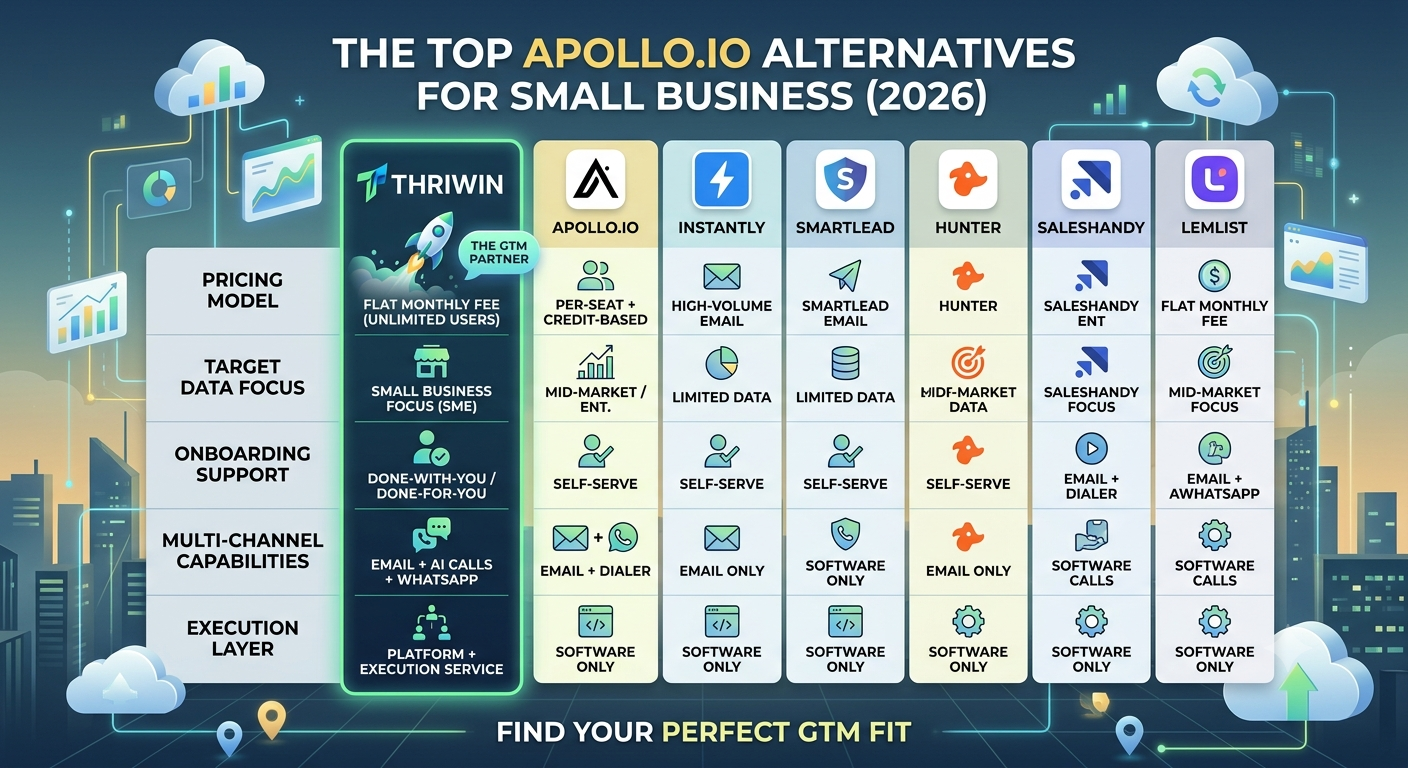
Quick comparison table
Six alternatives, each solving a different part of the problem. Apollo is included for reference. Prices are monthly billing unless noted.
| Apollo.io | Clay | Thriwin | Instantly | Smartlead | Reply.io | Lemlist | |
|---|---|---|---|---|---|---|---|
| Starting price | $49/user/mo | $185/mo | Free to start. $100/mo paid. | $47/mo | $39/mo, $94 real | $49/user/mo | $69/mo workspace |
| Per-seat pricing | Yes | No - unlimited seats | No - unlimited users | No | No | Yes | Only on multichannel |
| Lead data included | 240M+, credit-metered | 150+ providers, metered | Yes - built in | Separate subscription | None, bring your own | 1B+, 50 credits/mo | 650M+, credits metered |
| Email outreach | Yes | Sequencer, secondary | Yes | Yes - core strength | Yes - core strength | Yes | Yes |
| AI calling | Manual dialer | No | Yes - native AI calling | No | No | +$29/mo add-on | Dialer on $109 plan |
| LinkedIn automation | Manual tasks | Via integrations | No | No | No | Yes | Yes - best in class |
| No | No | Yes | No | No | Semi-automated | Paid add-on | |
| Someone helps run it | No - self-serve | No | Yes - done-with-you | No | No | AI SDR from $500/mo | Enterprise only |
| Campaign live in | Weeks (needs expertise) | Weeks (steep curve) | Days | 1-2 weeks | 1-2 weeks | 1-2 weeks | 1-2 weeks |
| Free option | Free plan | Free plan | Free plan, 200/day | 14-day trial | Free trial | 14-day trial | 14-day trial |
1. Clay
Clay attacks Apollo's core claim directly. Where Apollo sells you one database, Clay runs waterfall enrichment across 150+ data providers, querying them in sequence until one returns a match. For hard-to-find contacts, the hit rate is meaningfully better than any single vendor including Apollo.
Important if you are comparing quotes: Clay overhauled its pricing on 11 March 2026. The Starter ($149), Explorer ($349) and Pro ($800) tiers most articles still describe are retired for new customers, replaced by Launch and Growth. Data marketplace costs dropped 50-90% in the same change. Existing customers keep legacy pricing indefinitely, but the window to switch between legacy tiers closed in April 2026.
Where Clay beats Apollo
- Unlimited seats on every plan. Pricing scales with usage, not headcount. For a growing team this is the single biggest structural difference.
- Waterfall enrichment across 150+ providers. If Apollo doesn't have the contact, Clay tries fourteen other sources before giving up.
- Data Credits roll over up to 2x your monthly allowance on Launch and Growth. Apollo's credits simply expire.
- Genuine automation depth. AI research, conditional logic, HTTP APIs and CRM sync on Growth. Apollo gates API access to Custom plans entirely.
Where Clay falls short for small businesses
- It is expensive at entry. $185/month against Apollo's $49, and Growth at $495 is the first tier with CRM integration and HTTP APIs.
- Two meters, not one. Data Credits for enrichment and Actions for platform work. A 10-step workflow on 1,000 contacts can consume 10,000-25,000 credits combined. Top-ups carry roughly a 30% markup.
- Actions don't roll over, even though Data Credits do.
- The learning curve is the steepest on this list. Clay rewards people who think like engineers. Reviewers routinely say it gets expensive fast if you don't know how to build waterfalls properly.
- It is not really an outreach tool. There is a native sequencer, but Clay's job is finding and enriching. Most teams pair it with a separate sending tool, which is another line item.
Technical teams and growth operators who want maximum data coverage and are willing to invest real time learning the tool. If you found Apollo's data thin and you have someone who enjoys building workflows, Clay is the upgrade. If nobody on your team wants that job, it will sit unused faster than Apollo did.
2. Thriwin
Full disclosure: this is us. We'll be as honest about our limitations as we are about everyone else's. If Thriwin isn't the right fit, the five alternatives around it might be.
Thriwin was built for the problem that makes Apollo hard at small companies: the tool is powerful, but nobody runs it.
Where Apollo gives you a database, a sequencer and a dialer and says "go," Thriwin brings the lead data, sets up your channels (email, AI calling, WhatsApp, landing pages, ads), and works alongside you until the first campaign is live. That execution layer is the core difference. Most customers are live in days.
Where Thriwin beats Apollo
- No per-seat pricing. Add the whole team at no extra cost. For a 5-person team, that alone saves $245-595/month against Apollo's paid tiers.
- Flat pricing with no credit system. $100/month, redeemable against AI call and token credits. No expiry, no $0.20 overages, no fair use formula to decode.
- Multi-channel by default. Email, AI calling, WhatsApp, landing pages and ads configured together. Apollo does email and has a dialer; the rest needs separate tools.
- Hands-on execution. We set the first campaign up with you. Apollo's onboarding assumes you already know the platform.
Where Apollo beats Thriwin
- Database size. 240M+ contacts with deep firmographic, intent and technographic filters. Ours is smaller. We optimise for fit over raw count, but if you need to pull enormous lists across many geographies, Apollo wins outright.
- CRM integrations. Apollo's native Salesforce and HubSpot sync is more mature than ours.
- Intelligence layer. Buying intent signals, job change alerts, website visitor identification and company news triggers. We don't match that.
- Self-serve depth at scale. If you already have a RevOps person who knows how to run outbound tools, Apollo's depth rewards them. Our done-with-you model is most valuable when you don't have that person.
- No LinkedIn automation. Neither does Apollo, but Lemlist and Reply.io both do, and if LinkedIn is your primary channel you should buy one of those instead.
"I tried Mailchimp, HubSpot, Apollo - none generated a single lead. They all needed someone to run them. Thriwin was different. I set it up, and it worked. 9 meetings in the first month."
- Tim Thomson, CyberTrends, MSP Business Consulting
Non-technical founders, small sales teams, and service businesses (MSPs, legal firms, consultants) that need pipeline now and don't have the time or expertise to configure and run a sales platform alone. Not for agencies, LinkedIn-first teams, or anyone sending 100K+ emails a month.
3. Instantly
If your entire outbound motion is cold email and you want to send a lot of it cheaply, Instantly is the most cost-effective option here. Unlimited email accounts and unlimited warmup on every paid tier matter, because the modern deliverability playbook is spreading sends across many mailboxes rather than hammering one.
Where Instantly beats Apollo
- Deliverability. Built-in warmup, inbox rotation and placement tooling. This is Apollo's weakest area, with some users reporting inbox rates as low as 23%.
- No per-seat pricing. The whole team shares one account.
- Cheaper at volume. Sending 100,000 emails a month through Apollo gets expensive fast; Hypergrowth handles it at $97.
Where Apollo beats Instantly
- Data quality and depth. Instantly's B2B Lead Finder is newer and less proven than Apollo's database.
- The modular pricing hides the real number. Sending is $47, the lead database is another $47, the CRM is another. A working stack commonly lands at $124-180+/month.
- Single channel. No dialer, no LinkedIn, no intent data. Apollo is a far broader product.
- The 1,000-contact cap on Growth is tight. Most teams outgrow it within a quarter.
Teams that only need cold email, want to send high volume, and are comfortable writing their own sequences and managing their own campaigns.
4. Smartlead
Smartlead is the agency favourite and genuinely best-in-class at one thing: sending cold email at scale with strong deliverability. Where it differentiates from Instantly is agency infrastructure, with white-label client portals, multi-client separation and per-client API keys.
The $39 Base plan is not a real starting point. It caps at 2,000 leads and 6,000 emails a month, which most users call effectively unusable. Pro at $94/month is where actual work begins.
Where Smartlead beats Apollo
- No per-seat pricing. A 10-person team pays the same as a solo founder.
- Agency features Apollo simply doesn't have. White-label portals and multi-client management.
- Deliverability infrastructure, including inbox rotation and dedicated IP options.
Where Smartlead falls short
- No lead data at all. This is the opposite of Apollo's strength. You build the list elsewhere and upload it. SmartProspect is a separate add-on and early reviews call it basic.
- The real cost is 3-5x the sticker. Mailboxes, domains, external verification and the SmartDelivery add-on put a small team at $300-600/month.
- Support is the number one complaint. 4.6 on G2 across 306 reviews but only 3.4 on Trustpilot, with roughly half of negative Trustpilot reviews about customer service.
- Email-only. No LinkedIn, no WhatsApp, no intent data.
Lead gen agencies and high-volume senders managing many client inboxes, who already have their own data. More detail in our Smartlead alternatives comparison.
5. Reply.io
Reply.io covers more channels than Apollo does: email, LinkedIn, calls, SMS and WhatsApp in one conditional sequence builder, backed by a 1B+ contact database. If your problem with Apollo is that LinkedIn is manual task reminders and there's no SMS, Reply.io closes that gap.
Where Reply.io beats Apollo
- Genuine multichannel sequencing. LinkedIn automation, SMS and a dialer inside the same workflow.
- Email Volume gives unlimited users and mailboxes subject to fair use, so email-first teams of five or more often pay less than on Apollo's per-seat model.
- SOC 2 compliance, which matters if you sell into regulated buyers.
Where Reply.io falls short
- Add-ons stack fast. On Email Volume, LinkedIn automation is $69 per account per month and calls and SMS are $29. True multichannel there gets expensive quickly.
- Only 50 live data credits per month on most plans. That 1B+ database is barely accessible without buying packages.
- Still per-seat on the Multichannel plan, so it shares Apollo's core structural problem.
- Interface feels dated and reviewers consistently describe the hybrid pricing as confusing.
Teams that genuinely use four or more channels and want one tool that does all of them competently, rather than a database with sequencing attached.
6. Lemlist
Lemlist restructured its plans in 2026, and this matters for anyone comparing against Apollo's per-seat model. The Email plan is now priced per workspace with unlimited users, which for an email-only team of five is dramatically cheaper than five Apollo seats.
The catch is that LinkedIn, calling, WhatsApp and phone numbers only exist on Multichannel Expert at $109 per user, which reintroduces exactly the per-seat problem you left Apollo to escape.
Where Lemlist beats Apollo
- Native LinkedIn automation. Profile visits, connection requests, messages and AI voice notes inside the same sequence as email. Apollo offers manual task reminders only.
- Personalization depth. Dynamic images, personalized landing pages and liquid syntax. Apollo's personalization is basic by comparison.
- The $69 workspace plan has no seat count for email-only teams.
- Larger database. 650M+ leads against Apollo's 240M+, though raw count is a weak proxy for quality.
Where Lemlist falls short
- Multichannel is per user. A 5-person team on Multichannel Expert pays $545/month.
- Credits expire monthly with no rollover, same complaint as Apollo. A verified email is 5 credits, a phone number 20, and LinkedIn engagement signals start at 400 credits (about $4 each).
- You cannot switch plan families. Moving from Email to Multichannel means creating a new team and manually migrating contacts.
- No hands-on onboarding below Enterprise.
Teams selling high-ACV deals where LinkedIn is a primary channel and personalization justifies the setup time. Full breakdown in our Lemlist alternatives comparison.
When Apollo is still the right choice
We said we'd be honest. Here is when Apollo.io is the best option and you should just use it:
- You have a dedicated RevOps or sales ops person. Someone who builds sequences, manages deliverability, configures enrichment and reads the data. Apollo's depth rewards expertise; it does not teach it.
- Finding contacts is your actual bottleneck. 240M+ contacts with intent, technographic and firmographic filters at a self-serve price is genuinely hard to beat. Clay covers more sources but costs $185 to start and demands more skill.
- You want the free tier to validate an ICP. Apollo's free plan is the cheapest way to find out whether enough of your ideal customers even exist to build a motion around.
- You need Salesforce or HubSpot depth. Apollo's CRM integrations are more mature than most alternatives here.
- You're already using Apollo and it's working. Switching a working system introduces risk for marginal gain. Don't.
Apollo is a great tool for companies that have the people to run it. The question is whether you have that person.
Our honest take
Key takeaways from this article
- Apollo is powerful, but power without someone to wield it is shelfware. The number one reason small businesses leave isn't price or features. It's that the platform sat unused because nobody had the time or expertise.
- The database is 240M+, not the 275M+ most articles claim. Check any comparison you read against Apollo's own site, including the earlier version of this one.
- "Unlimited" has a formula. Apollo's fair use policy caps it at what you paid divided by $0.025, or 1 million credits a year, whichever is lower.
- Real cost runs $150-400 per user per month against a $49 sticker, and credits expire with no rollover.
- Per-seat pricing punishes the companies that need the tool most. Clay, Thriwin, Instantly and Smartlead all price without seats.
- Data quality matters more than database size. If your ICP is other small businesses, expect to delete 40-45% after cleanup. A smaller, cleaner dataset beats a large noisy one.
- You can run Apollo alongside an alternative. Keep it for database access, use something else for execution. You don't have to choose.
The real question
Most small businesses looking for Apollo alternatives aren't looking for a different tool. They're looking for a different outcome.
The tool wasn't the problem. The missing piece was someone to run it.
If you need deeper data and have someone technical, look at Clay. If you need cheaper email volume, look at Instantly. If you need LinkedIn, look at Lemlist or Reply.io.
But if the real problem is that you signed up for a sales tool, nobody ran it, and you still don't have pipeline - that's the problem Thriwin was built to solve.
Your first campaign could go live this week.
Lead data included. Email + AI calling + WhatsApp configured with you. No per-seat pricing, no credit system, no "figure it out yourself."
No long contracts. No credit card required. Cancel anytime.
FAQ
How much does Apollo.io cost in 2026?
Apollo has four tiers. Free, Basic at $49 per user per month, Professional at $79, and Organization at $119, all on annual billing. Monthly billing raises those to roughly $59, $99 and $149. Organization carries a three-seat minimum, making its real entry price $357/month or $4,284/year. Credits are consumed on top: 1 per verified email, 8 per phone number, and 2 per minute on the US dialer.
Is Apollo.io good for small businesses?
Apollo is good software with a strong database. But for small businesses without a dedicated sales ops person, the tool often sits unused because nobody has the expertise and time to run it. The credit system also makes costs unpredictable as you scale. If you have someone who knows how to configure and optimise sales tools, Apollo is a solid choice. If you don't, look for alternatives that include setup support.
How big is Apollo's database really?
Apollo's own website states 240M+ contacts and 30M+ companies. Many comparison articles still cite 275M+, which is out of date. Coverage is strongest for mid-market and enterprise contacts; users report deleting 40-45% of records for small-company and niche-industry lists after cleanup.
Do Apollo credits roll over?
No. Apollo states that unused credits expire at the end of each billing cycle and do not carry into the next one. On annual plans the full year of credits is released upfront, so pacing is left to you. Overage credits cost $0.20 each with a 250-credit minimum purchase.
What's the main difference between Apollo and Thriwin?
Apollo gives you the software - a database, sequencer and dialer - and you run it yourself. Thriwin gives you the lead data, sets up multi-channel outreach (email, AI calling, WhatsApp, landing pages, ads), and works alongside you to launch and optimise campaigns. Apollo is a tool. Thriwin is a tool plus a GTM partner.
Is Clay a good Apollo alternative?
For data coverage, yes. Clay runs waterfall enrichment across 150+ providers and includes unlimited seats on every plan, which removes Apollo's per-seat problem. But Clay starts at $185/month against Apollo's $49, runs two separate credit meters, and has the steepest learning curve of any tool in this comparison. It suits technical growth operators, not founders looking for something simple.
Can I use Thriwin alongside Apollo?
Yes. Many customers use Thriwin alongside existing tools. The difference is execution - Thriwin comes with the setup and hands-on support, not just access. You don't need to replace Apollo to add Thriwin, though most customers find they don't need both once Thriwin is running.
Sources
Pricing, ratings, and feature claims in this article were verified against the following sources in August 2026.
- Apollo.io - Pricing page and FAQ (fair use policy, credit rules, 4.7/5 across 9,690 reviews)
- Apollo.io - Homepage (240M+ contacts, 30M+ companies, 600,000+ companies)
- Apollo.io - G2 Reviews
- Clay - Pricing page (Data Credits, Actions, rollover rules)
- Lemlist - Pricing page
- Instantly - Pricing page
- Reply.io - Pricing page
- Smartlead - Pricing page
- Smartlead - Trustpilot Reviews (3.4/5)
- Thriwin - Pricing page

.webp)
.webp)